
How Websites Display Real-Time Clocks (And Why They’re Not Always Accurate)
At first glance, a real-time clock on a website feels simple—just numbers ticking every second. But here’s the catch: most…
 Ethan Caldwell
April 30, 2026
10 min read
Ethan Caldwell
April 30, 2026
10 min read
 By Ethan Caldwell
·
August 1, 2026
By Ethan Caldwell
·
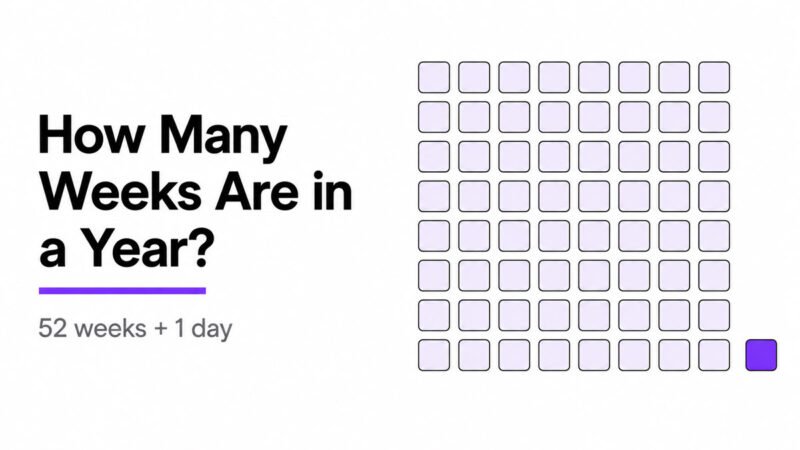
August 1, 2026Many people confidently say there are 52 weeks in a year—but that’s only part of the story. While 52 is the standard answer, a calendar year doesn’t divide perfectly into weeks. That’s why you’ll sometimes hear about 52 weeks and 1 day, 52 weeks and 2 days, or even a mysterious Week 53.
If you’ve ever wondered why these answers seem to conflict, you’re not alone. The good news is that the explanation is surprisingly simple once you understand how days and weeks fit together.
A typical calendar year contains 52 weeks, but that’s not the complete answer.
| Year Type | Days | Weeks | Extra Days |
|---|---|---|---|
| Common Year | 365 | 52 | 1 day |
| Leap Year | 366 | 52 | 2 days |
So, when someone asks how many weeks are in a year, the everyday answer is 52 weeks. Technically, though, a common year has 52 weeks and 1 extra day, while a leap year has 52 weeks and 2 extra days.
That leftover day isn’t just trivia. Think about your birthday: it shifts forward one weekday every year (two after a leap year), and that single spare day is the entire reason why.
The answer comes down to simple math.
Every week has 7 days, so 52 weeks accounts for 364 days—one short of a full year.
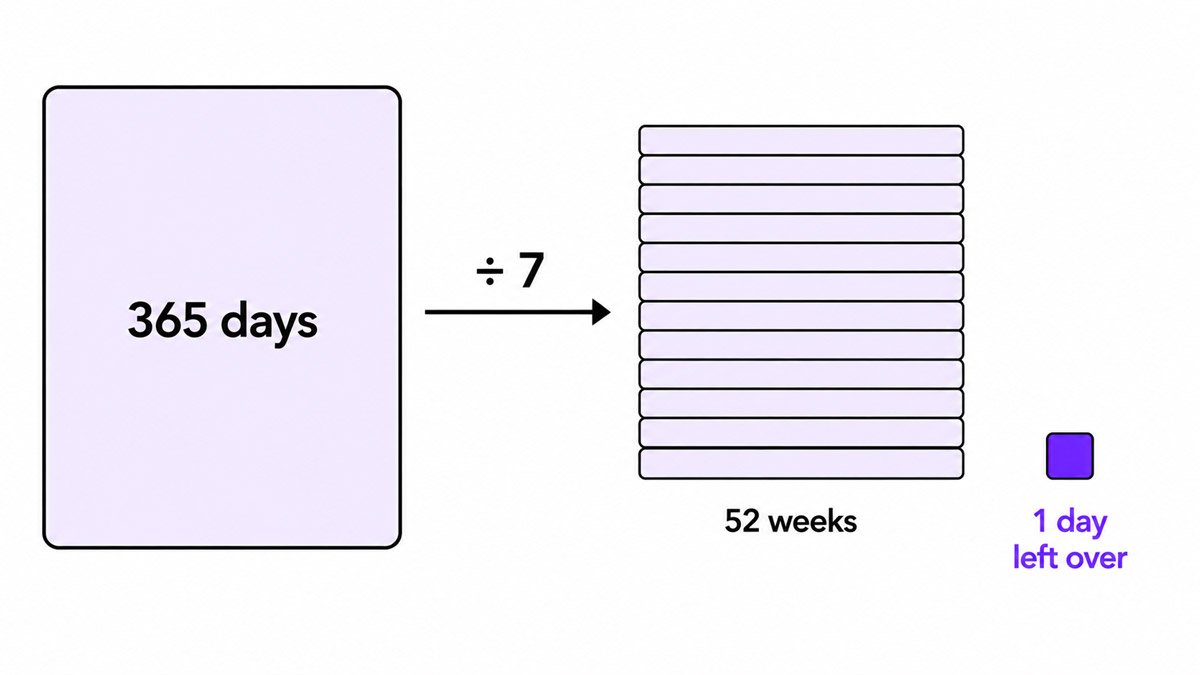
That leftover day (or two days during leap years) is why a year isn’t made up of exactly 52 complete weeks.
Think of it like slicing a pizza into equal pieces. If you divide 365 days into groups of seven, you’ll create 52 full groups and still have one day remaining.
Leap years include February 29, adding one additional day to the calendar.
Instead of:
You get:
This extra day helps keep our calendar aligned with Earth’s journey around the Sun. Without it, the seasons would slowly slide out of position—roughly a full day every four years, which adds up to about 24 days in a single century.
Most years are common years containing 365 days. Every four years (with a few exceptions), a leap year adds an extra day to February.
| Feature | Common Year | Leap Year |
|---|---|---|
| Total Days | 365 | 366 |
| Weeks | 52 + 1 day | 52 + 2 days |
| February | 28 days | 29 days |
For example:
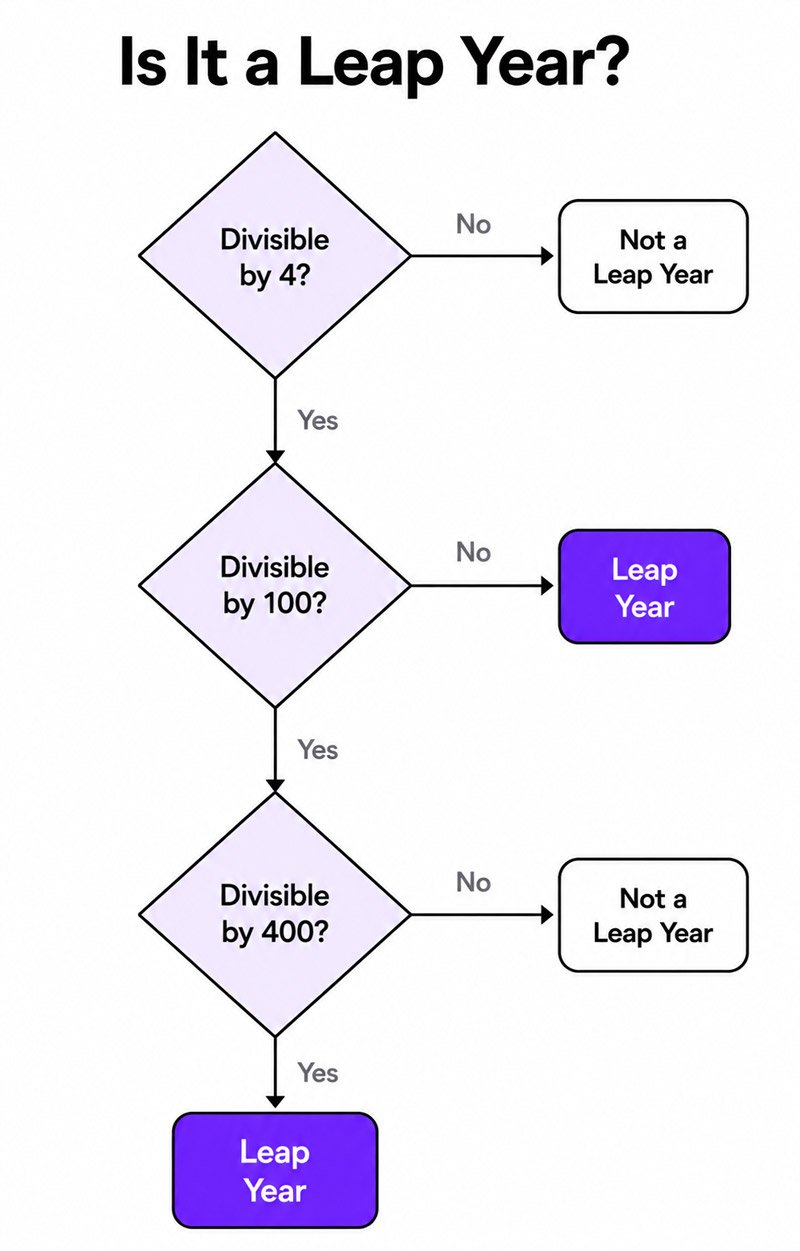
That last rule catches people off guard. The year 2000 was a leap year because it’s divisible by 400, which is why the exception rarely comes up in conversation—the next skipped leap year won’t arrive until 2100.
This is one of the most common calendar misconceptions.
Many people assume:
12 months × 4 weeks = 48 weeks
But months aren’t exactly four weeks long.
| Month Length | Equivalent |
|---|---|
| 28 days | 4 weeks |
| 30 days | 4 weeks + 2 days |
| 31 days | 4 weeks + 3 days |
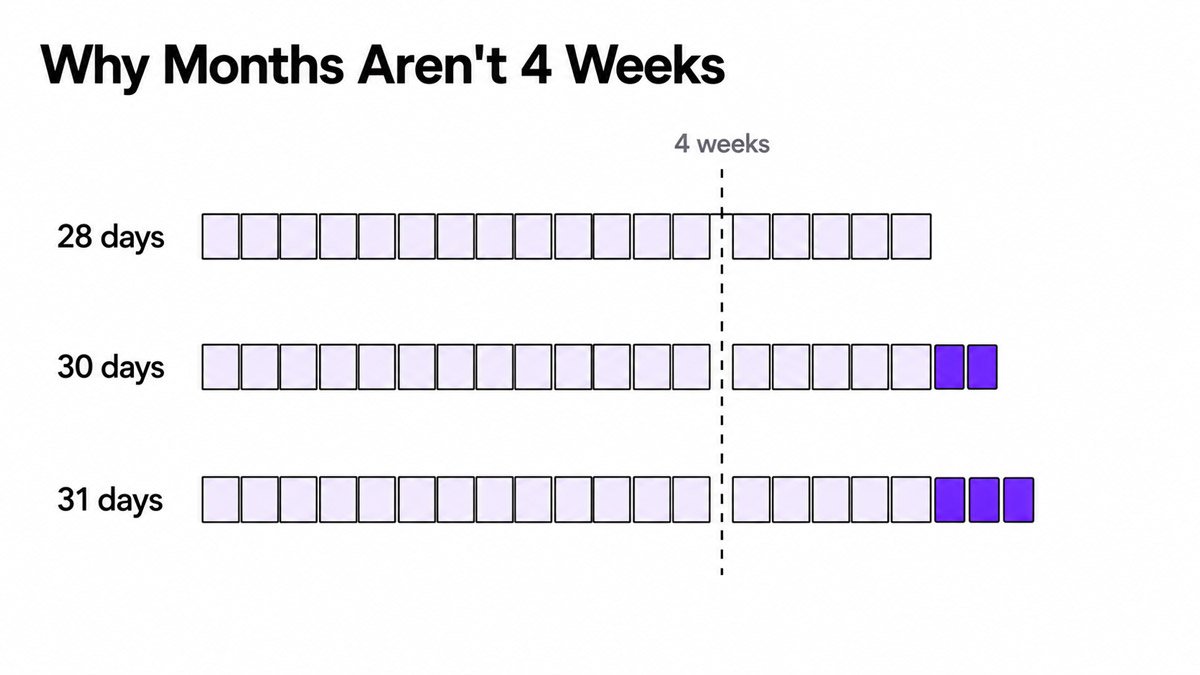
Those extra days add up throughout the year, which is why we end up with approximately 52 weeks instead of 48. Averaged out, a month runs closer to 4.35 weeks than a clean four.
This is also why some calendar months appear to contain five weeks, even though they don’t contain five full seven-day periods. It’s also why monthly and weekly pay cycles never line up neatly—anyone who has budgeted around a four-week paycheck and then hit a “three-paycheck month” has run into this math without realizing it.
If you’ve looked at business calendars or scheduling software, you may have noticed a Week 53.
This doesn’t mean the year suddenly has more than 365 or 366 days.
Instead, it’s the result of how certain calendar systems number weeks. The ISO 8601 standard—used across most of Europe and by a large share of business software—counts only whole Monday-to-Sunday weeks, so a week-numbering year runs 364 or 371 days rather than 365 or 366.
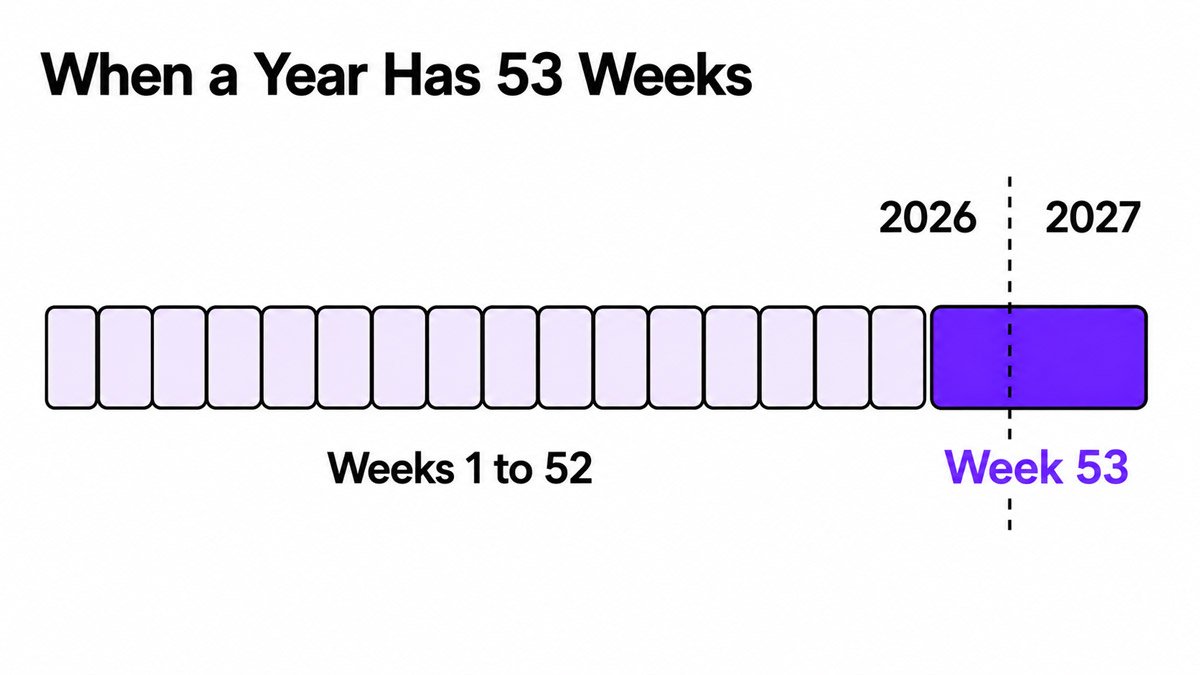
Under that system, a year gets a 53rd numbered week when January 1 falls on a Thursday, or when a leap year begins on a Wednesday. It happens roughly every five or six years. 2026 is one of them: January 1 landed on a Thursday, so its week numbers run all the way to 53, with the final week stretching into early January 2027. The next 53-week years are 2032 and 2037.
This mainly affects:
It’s a numbering convention, not an extra week added to the year. Still, it’s worth flagging early if your team plans in week numbers—retailers and finance teams often have to decide whether that 53rd week counts toward the current year’s targets or the next one. Mismatched week numbers between systems are also a familiar headache, and they can be compounded by something as ordinary as a device clock that has drifted out of sync.
The seven-day week has been used for centuries and eventually became the international standard.
Unlike the day, which is based on Earth’s rotation, or the year, which follows Earth’s orbit around the Sun, the week is a human-made time unit. Nothing in astronomy requires it. It stuck because it worked.
Today, nearly every modern calendar uses seven-day weeks, making it one of the most familiar ways to organize time—and, quietly, one of the most important. Shared units of time are what let banks, airlines, and servers agree on when something happened, which is a big part of why accurate timekeeping matters so much to the internet.

Many businesses organize projects, payroll, and planning around weekly cycles instead of monthly ones, mostly because a week is a fixed length while a month isn’t. Comparing two 30-day months is easy; comparing February to March is not.
A typical school year in the United States usually includes around 36 instructional weeks, although this varies by district.
Medical professionals commonly measure pregnancy in weeks rather than months, with a full-term pregnancy lasting about 40 weeks. Weeks are simply more precise—”32 weeks” describes a stage of development far more accurately than “about seven months.”
Many people break annual goals into weekly milestones because 52 smaller goals often feel more manageable than one large yearly objective. Whether you track those weeks on a wall planner or a digital dashboard is personal preference, though the trade-offs between online and physical timekeeping are worth thinking through if you rely on one heavily.
No. It contains 52 complete weeks plus one or two extra days.
No. Only a 28-day February has exactly four weeks. Every other month contains additional days.
No. Week 53 is simply part of certain week-numbering systems.
No. A leap year adds only one extra day—not another week.
| Question | Answer |
|---|---|
| Weeks in a common year | 52 weeks + 1 day |
| Weeks in a leap year | 52 weeks + 2 days |
| Days in a week | 7 |
| Months in a year | 12 |
| Average weeks per month | About 4.3 |
| Can a calendar have Week 53? | Yes |
Both answers are correct depending on context. For everyday use, a year has 52 weeks. Mathematically, 365 days equals about 52.14 weeks.
365 days equals 52 weeks and 1 extra day.
A leap year has 52 weeks and 2 extra days.
Some calendar systems number weeks differently, allowing certain years to include a Week 53 without adding extra days. Under ISO 8601, it happens when January 1 falls on a Thursday, or when a leap year starts on a Wednesday.
That depends on holidays, vacation time, and your work schedule. The calendar itself still contains 52 weeks.
The simplest answer is that there are 52 weeks in a year. However, understanding the complete picture makes calendar math much easier. A common year actually contains 52 weeks and 1 extra day, while a leap year contains 52 weeks and 2 extra days. Those leftover days explain why calendars don’t divide perfectly into weeks and why some systems occasionally include a Week 53.
Here’s the part most explanations skip: the calendar isn’t confusing because it’s badly designed. It’s confusing because we’re forcing a human invention—the seven-day week—onto an astronomical cycle that never agreed to cooperate. Once you accept that mismatch, the leftover days and the odd Week 53 stop looking like errors and start looking like the calendar doing exactly what it was built to do. That’s a far more useful thing to carry around than a memorized number.
At first glance, a real-time clock on a website feels simple—just numbers ticking every second. But here’s the catch: most…
Ethan Caldwell
April 30, 2026
10 min read
How time travels from atomic clocks to your watch Role of phone, internet, GPS, and cellular networks How the internal…
Ethan Caldwell
April 30, 2026
9 min read
Online clocks and physical clocks solve different problems. Online clocks excel in accuracy, automation, and multi-device access. Physical clocks offer…
Ethan Caldwell
May 22, 2026
15 min read