
How Samsung Galaxy Watch Maintains Accurate Time (Complete Breakdown)
How time travels from atomic clocks to your watch Role of phone, internet, GPS, and cellular networks How the internal…
 Ethan Caldwell
April 30, 2026
9 min read
Ethan Caldwell
April 30, 2026
9 min read
 By Ethan Caldwell
·
June 9, 2026
By Ethan Caldwell
·
June 9, 2026Many people assume a smart clock is automatically better because it does more. More features, more connectivity, more convenience. But that assumption isn’t always true.
A clock sits in one of the most personal spaces in your life—your bedroom, office, kitchen, or living room. The right choice isn’t necessarily the one with the most technology. It’s the one that fits how you actually live.
For some households, a smart clock becomes a useful hub that manages schedules, controls lights, and simplifies mornings. For others, a traditional clock delivers something technology often struggles to provide: simplicity, reliability, and freedom from distractions.
If you’re trying to decide between a smart clock and a traditional clock, this guide breaks down the differences in practical terms so you can choose with confidence.
A smart clock is a connected device that combines traditional timekeeping with digital features typically found in smartphones and smart home systems. Instead of only displaying the time, a smart clock can provide information, automation, and voice-controlled assistance throughout the day.
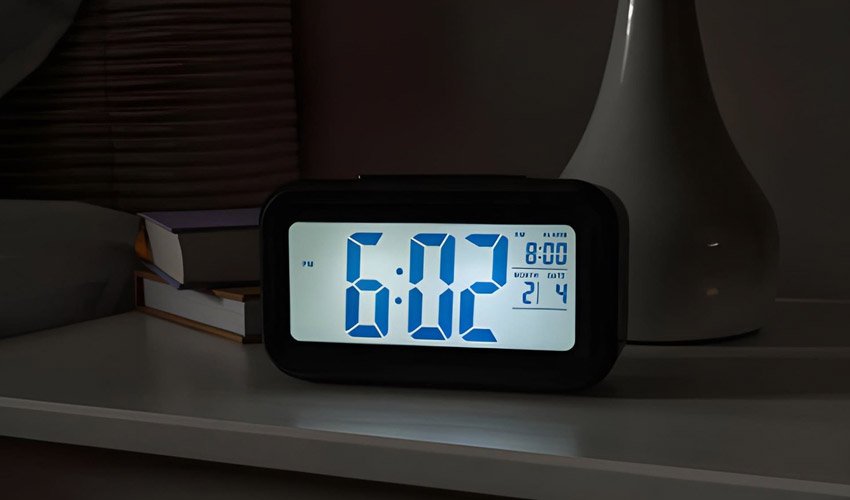
Most smart clocks connect to Wi-Fi and sync with internet time servers, which means they automatically maintain accurate time without manual adjustments. Many models also connect to other devices in your home through platforms such as Alexa or Google Assistant. Once connected, the clock becomes more than a clock — it becomes part of your broader smart home ecosystem. If you’re curious about how that synchronization actually works, this overview of how real-time clocks are displayed and maintained online explains the underlying mechanics well.
For example, a smart clock can gradually brighten your room before your alarm goes off, then read your morning schedule while turning on connected lights. That’s a very different experience from a standard bedside clock.
While each device differs slightly, they all focus on combining timekeeping with convenience and connectivity.
A traditional clock focuses on a single primary function: displaying time. Whether analog, digital, quartz, or mechanical, traditional clocks prioritize simplicity and reliability over advanced technology.

Many people use these terms interchangeably, but they aren’t exactly the same.
All of these can be considered traditional clocks because their primary purpose remains straightforward timekeeping.
Most traditional clocks can operate for months or even years without requiring significant attention.
Technology has transformed many household items, yet traditional clocks remain surprisingly relevant. The reason is simple: they solve a problem efficiently. Many people don’t want notifications, voice assistants, or internet connectivity in every room. They simply want to know the time. A traditional clock provides that without updates, passwords, apps, subscriptions, or connectivity concerns.
The easiest way to understand the differences is to compare the categories that matter most in daily use.
| Category | Smart Clock | Traditional Clock |
|---|---|---|
| Time Accuracy | Automatic synchronization | May require occasional adjustment |
| Setup | More complex | Simple |
| Features | Extensive | Basic |
| Smart Home Integration | Yes | No |
| Privacy | Potential concerns | Minimal concerns |
| Power Dependence | Higher | Lower |
| Maintenance | Software updates | Battery replacement |
| Reliability | Technology dependent | Highly reliable |
This category clearly favors smart clocks. A smart clock can act as a bedside assistant, smart home controller, weather station, media player, and scheduling tool. A traditional clock intentionally avoids those functions. Whether that is an advantage or disadvantage depends entirely on your priorities.
Traditional clocks win here. Most require little more than inserting batteries and setting the time. Smart clocks often require Wi-Fi setup, account sign-ins, app installation, device linking, and voice assistant configuration. For tech-savvy users this is manageable. For others, it can become frustrating.
Smart clocks maintain excellent accuracy because they synchronize automatically with internet time servers. Traditional clocks are still accurate enough for everyday use but may drift slightly over time — you’ll occasionally need to reset them, particularly after battery changes or seasonal time shifts. Understanding why precise timekeeping matters makes it easier to appreciate why that automatic sync is more than a convenience feature.
This is where traditional clocks often outperform smart alternatives. A battery-powered analog clock continues operating regardless of internet status. Some smart clocks lose functionality when disconnected from Wi-Fi; others may reboot after power interruptions. It’s worth noting that many newer smart clock models do retain basic timekeeping and alarm functions locally, even without a network connection — but the broader feature set typically goes dark. If reliability is your highest priority, traditional clocks still hold a strong advantage.
Traditional clocks need very little maintenance — most require nothing more than occasional battery replacement. Smart clocks require software updates, network connectivity, security patches, and periodic troubleshooting. While none of these tasks are difficult, they add ongoing responsibilities that traditional clocks simply don’t have.
Battery performance is one of the most overlooked differences between a smart clock and a traditional clock. Most traditional clocks are remarkably efficient — a basic quartz clock can often run for a year or longer on a single battery. Smart clocks consume significantly more power because they maintain wireless connections, run displays, process voice commands, and support multiple features simultaneously. As a result, most smart clocks either remain plugged in at all times or require much more frequent charging. If energy efficiency and low maintenance matter to you, traditional clocks have a clear edge.
Durability is where traditional clocks continue to impress. A quality analog or quartz clock can remain functional for many years with minimal maintenance. Mechanical clocks often last decades when properly cared for.
Smart clocks face a different challenge: technological aging. Even when the hardware still works, software support may eventually end. Features that depend on apps, cloud services, or voice assistants can become outdated faster than the device itself. That’s why many traditional clocks outlast several generations of smart devices — and it’s a factor worth considering before spending $150 or more on a connected bedside gadget.
Initial pricing varies considerably.
| Clock Type | Typical Cost Range |
|---|---|
| Basic Traditional Clock | $10–$50 |
| Premium Traditional Clock | $50–$500+ |
| Smart Clock | $40–$250+ |
However, value is about more than purchase price. A traditional clock often provides years of service with virtually no additional costs. A smart clock may deliver greater convenience and functionality, making the higher price worthwhile for users who actively use those features. The key question is whether you’ll actually benefit from the extras — because a feature you ignore is just a feature you paid for.
Privacy is one area where smart clocks and traditional clocks differ dramatically — and it’s a gap that’s becoming harder to ignore.
Traditional clocks collect no data. They don’t connect to networks, listen for commands, or sync information. Smart clocks, on the other hand, often include microphones and persistent internet connectivity. Voice recordings, usage patterns, and device data can be stored in cloud environments, creating potential exposure points that simply don’t exist with a battery-powered wall clock. Most major manufacturers provide security controls and privacy settings, but the responsibility to configure and maintain them falls on the user. If privacy is a meaningful concern for your household, a traditional clock remains the simpler option by a significant margin.
This category overwhelmingly favors smart clocks. A smart clock can become a control center for smart lighting, thermostats, security systems, smart plugs, music systems, and automated routines. For households already invested in smart home technology, a smart clock can add meaningful convenience. Traditional clocks simply aren’t designed for this role.
Many people buy clocks specifically for the bedroom, making sleep quality one of the most important considerations.
Some smart clocks use bright displays that remain visible throughout the night. For sensitive sleepers, excessive brightness can be a genuine problem. Many newer smart clocks offer adaptive brightness controls, dimming modes, and nighttime settings, but the effectiveness varies by model. Traditional clocks generally create fewer light-related distractions, particularly analog models without illuminated displays.
Smart clocks do offer several features designed to improve sleep routines — sunrise simulation alarms, gradual volume increases, sleep sounds, white noise, bedtime reminders, and sleep tracking integration. For users who struggle with consistent sleep schedules, these features can be genuinely useful.
Traditional clocks provide something increasingly rare: silence from technology. There are no notifications, app alerts, news updates, or unexpected interruptions. Many people discover they sleep better when their bedroom contains fewer connected devices. That simplicity can become a significant benefit over time. If you’re weighing your options for the bedroom specifically, it’s also worth considering the broader comparison between online and physical clocks for a fuller picture.
A traditional alarm wakes you with sound. A sunrise alarm gradually increases light before your scheduled wake-up time, creating a gentler transition from sleep. People who dislike abrupt alarms often prefer this approach. However, if you simply need a dependable alarm that wakes you every morning, a traditional alarm clock remains highly effective.
If your home already uses voice assistants, smart lighting, and automation routines, a smart clock makes sense. It becomes a natural extension of the ecosystem you’ve already built.
Minimalists typically prefer traditional clocks. The straightforward design aligns with the goal of reducing unnecessary complexity and digital clutter.
This depends on comfort with technology. Large-display traditional clocks are often easier to use. However, voice-controlled smart clocks can also be helpful for seniors who appreciate hands-free functionality.
Traditional clocks are often better for younger children because they avoid unnecessary distractions. For older children, certain smart clocks with routines and educational features may be beneficial.
Interestingly, analog clocks can sometimes provide an advantage here. Seeing time physically move across a clock face helps some people visualize how much time remains before a task or deadline — a kind of spatial awareness that a purely digital display can’t easily replicate.
Smart clocks can automatically adjust time zones and synchronize schedules. However, compact traditional travel clocks remain popular because they’re simple, lightweight, and dependable.
Choose a smart clock if you want alarms, sleep tools, and automation. Choose a traditional clock if you prioritize fewer distractions and a calmer sleep environment.
Traditional clocks support focus. Smart clocks may be useful if you frequently rely on schedules, reminders, and voice assistance.
This choice often comes down to aesthetics. Traditional clocks can act as decorative centerpieces, while smart clocks complement modern interiors.
Both options work well. Smart clocks can provide timers, recipes, and voice controls. Traditional clocks offer quick visibility and simplicity.
A traditional clock is usually the better option because guests can use it immediately without learning any technology.
Many people wonder whether they need any clock at all when their smartphone already displays time and handles alarms.
The problem isn’t the alarm itself. The problem is everything else attached to the phone. Notifications, messages, social media, and emails often create distractions right before bed and immediately after waking up. A dedicated clock separates timekeeping from digital distractions — and that separation turns out to matter more than most people expect until they’ve actually tried it.
Many people report better bedtime habits when they stop relying on their phones as alarm clocks. Whether you choose a smart clock or traditional clock, having a dedicated device can help create healthier boundaries around screen time.
Not necessarily. A feature only adds value if you actually use it.
Traditional clocks continue to thrive because they solve a basic need efficiently. Sometimes the simplest solution remains the best solution.
Most smart clocks continue displaying time and running alarms without Wi-Fi. However, many advanced features — weather updates, voice assistants, calendar sync — may become unavailable. For a deeper look at how connected devices maintain accuracy when internet access is disrupted, this breakdown of how the Samsung Galaxy Watch keeps accurate time offers a useful parallel.
Analog clocks provide a visual representation of time passing, which many users find helpful for planning and time awareness.
| Your Priority | Best Choice |
|---|---|
| Smart Home Integration | Smart Clock |
| Sleep-Friendly Environment | Traditional Clock |
| Ease of Use | Traditional Clock |
| Advanced Features | Smart Clock |
| Privacy | Traditional Clock |
| Automation | Smart Clock |
| Long-Term Durability | Traditional Clock |
The smart clock vs traditional clock debate isn’t really about technology versus tradition. It’s about choosing the right tool for the environment where it will be used.
Smart clocks excel when convenience, automation, and connectivity are priorities. They can simplify routines, integrate with smart homes, and provide information at a glance. Traditional clocks excel when reliability, simplicity, privacy, and distraction-free living matter most — they require little attention, often last longer, and perform their core job exceptionally well.
If you’re building a connected home and enjoy technology, a smart clock is likely worth the investment. If your goal is better sleep, fewer distractions, and dependable timekeeping, a traditional clock remains surprisingly hard to beat.
In many homes, the smartest choice isn’t replacing traditional clocks altogether — it’s using each type where it performs best. One on the nightstand. One in the kitchen. The right tool in the right room.
Yes, if you’ll regularly use features like voice assistants, smart home controls, weather updates, and advanced alarm functions. Otherwise, a traditional clock may provide better value.
Most smart clocks continue displaying time without Wi-Fi, but features such as weather updates, voice assistants, and online synchronization may stop working.
Not necessarily. Some improve sleep with sunrise alarms and bedtime routines. However, bright displays and additional distractions can negatively affect some sleepers.
A smart clock is better for automation and sleep tools. A traditional clock is often better for minimizing distractions and creating a calmer sleeping environment.
A digital clock simply displays time electronically. A smart clock includes internet connectivity, voice assistants, automation features, and smart home integration.
For some people, yes. Analog clocks visually represent the passage of time, making it easier to estimate remaining time and manage tasks.
Traditional clocks generally last longer because they aren’t dependent on software, internet services, or evolving technology platforms.
Yes. Many people find smart clocks provide a better waking experience while reducing phone-related distractions in the bedroom.
Most reputable smart clocks include security features, but they still collect more data than traditional clocks because of their internet connectivity and voice capabilities.
Large-display traditional clocks are often easiest to use. However, voice-controlled smart clocks can be beneficial for seniors who prefer hands-free assistance.
How time travels from atomic clocks to your watch Role of phone, internet, GPS, and cellular networks How the internal…
Ethan Caldwell
April 30, 2026
9 min read
What would happen if the internet suddenly lost track of time? It sounds harmless — maybe a few wrong timestamps,…
Ethan Caldwell
April 29, 2026
10 min read
A Windows clock that is only a few minutes off can cause far more problems than most people realize. It…
Ethan Caldwell
June 19, 2026
10 min read